Speed Settings in Stand Mixers: What It Is and Is It Worth It?
As an Amazon Associate we earn from qualifying purchases. Links on this page are affiliate links.
Understanding Speed Settings in Mixers
Speed settings refer to the number of distinct rotational speeds a stand mixer offers. This spec tells you how finely you can control the beaters or dough hooks. It is not about raw power. It is about precision. You use these settings to match the task at hand.
Most models fall into specific categories. You will see options for 3 speeds, 5 speeds, 6 speeds, 7 speeds, 9 speeds, and 12 speeds. Some high-end units go even higher. The number indicates the steps between the slowest stir and the fastest whip. More steps mean finer control.
How it works is straightforward. A lower number, like 3 or 5, gives you broad ranges. You might have a low stir, a medium beat, and a high whip. This is often enough for basic bread doughs or simple batters. It is less precise but easier to manage for beginners.
Higher counts, such as 9 or 12, offer granular adjustments. This matters when you are folding delicate ingredients or whipping egg whites to soft peaks. You can find the exact speed without jumping too far up the scale. This prevents overmixing or deflating your mixture.
Buyers care about this spec because it affects texture. If you need to incorporate air gently, having more options helps. It allows you to start slow and increase gradually. This is critical for meringues and custards. For heavy cookie dough, fewer speeds may suffice.
When reading listings, look for the exact count. It is usually listed as a key feature. Do not assume more is always better. Consider what you bake most. If you stick to simple cakes, a standard 5 or 7 speed model is practical. If you bake intricate pastries, seek out the higher counts. The right choice depends on your specific needs in the kitchen.
Understanding speed settings explained helps you choose a tool that fits your routine. It is a simple spec with a real impact on your baking results.
Speed Settings Compared
3 Speeds
Three speed settings offer the broadest range of rotational speeds with minimal complexity. This configuration is designed for heavy-duty tasks rather than delicate precision. You typically use the lowest speed for combining ingredients and the highest for kneading stiff dough. The VEVOR 10-Quart Commercial Stand Mixer exemplifies this approach. Its large capacity and limited speeds suit commercial kitchens that prioritize power and durability over versatility. If you mainly mix bread or pizza dough, this simplicity reduces mechanical points of failure. However, you cannot easily adjust for soft batters or whipped cream. This option is best for users who do not need fine control over mixing textures.
5 Speeds
Five speed settings provide a standard baseline for home baking needs. This range covers most common tasks from slow stirring to fast whipping. The KitchenAid 5-Speed Hand Mixer demonstrates how this count balances simplicity with utility. You can manage basic mixing tasks without navigating a complex interface. This setup is ideal for users who want reliable performance without unnecessary features. The trade-off is that you may lack the intermediate speeds needed for very delicate ingredients. If your baking repertoire is limited to cakes, cookies, and simple batters, five speeds are sufficient. You gain ease of use but sacrifice the ability to make micro-adjustments during the mixing process.
6 Speeds
Six speed settings add an extra tier of control compared to five-speed models. This increment allows for slightly better differentiation between soft and stiff mixing phases. The Hamilton Beach 6-Speed Hand Mixer uses this configuration to offer a balanced mix of options and stability. You benefit from a dedicated speed for tasks that fall between standard low and high settings. This is practical for users who occasionally handle varied consistencies. The trade-off is minimal compared to higher counts, as the added speed may not justify the complexity for every baker. It is a solid choice for small batch mixing where bowl stability is also a priority. You get slightly more precision without overwhelming the user with too many choices.
7 Speeds
Seven speed settings provide a versatile middle ground for home bakers. This count offers more granularity than five speeds but remains manageable for daily use. The Showvigor 7-Speed Hand Mixer illustrates how this range suits users needing more than basic control. You can find a specific speed for tasks like folding in flour or whipping egg whites. This setup is best for those who value versatility and easy storage. The trade-off is that it does not reach the extensive range of professional models. If you bake frequently and encounter a variety of recipes, seven speeds offer enough flexibility. You avoid the bulk of high-speed machines while retaining the ability to adjust for different ingredient textures.
9 Speeds
Nine speed settings allow for precise control over mixing intensity. This configuration is common in digital hand mixers that emphasize soft start features. The Yomelo 9-Speed Digital Hand Mixer uses these settings to prevent ingredient splashing. You can select a speed that matches the exact viscosity of your mixture. This is useful for mixing in batches rather than large volumes. The trade-off is that the increased number of settings may be unnecessary for simple recipes. However, for users who value precision, the extra options reduce guesswork. You gain the ability to fine-tune the mixing process, which can improve texture consistency. This option is best for those who want to optimize their technique with detailed speed adjustments.
12 Speeds
Twelve speed settings offer the highest level of manual control available in this list. This configuration allows for micro-adjustments across a wide range of tasks. The Cuisinart 5.5-Quart 12-Speed Tilt-Head Stand Mixer exemplifies this precision. You can find the exact speed for delicate meringues or heavy bread dough. This is practical for bakers who value precise manual control and durable construction. The trade-off is a more complex interface and potentially higher cost. However, for those who plan to use additional attachments, the versatility is valuable. You get the ability to tailor every step of the mixing process. This option is best for serious home bakers who want maximum flexibility and precision in their equipment.
Is More Speed Worth It?
Who needs it
You should prioritize higher speed counts if your baking routine demands fine control over texture. Models offering twelve speeds allow you to adjust rotational velocity in small increments. This precision is critical when working with delicate batters or meringues that can easily collapse if overmixed. Similarly, when incorporating air into egg whites, gradual speed increases prevent deflation. If you frequently switch between stiff cookie dough and airy cake batter, the ability to dial in exact speeds saves time and reduces waste. Seven or nine speeds provide a good middle ground, offering enough granularity for most home baking tasks without overwhelming complexity. These settings help you achieve consistent results across a wide variety of recipes, from dense breads to light soufflés, ensuring your mixer adapts to the specific needs of each ingredient.
Who can skip it
You can ignore high speed counts if your baking focuses on simple, forgiving recipes. Three or five speeds are often sufficient for standard tasks like mixing cookie dough or blending muffin batter. These lower counts reduce the risk of accidentally adding too much speed, which can splash ingredients or overwork gluten. If you prefer a straightforward interface with fewer buttons, fewer speeds mean less cognitive load. You should prioritize motor power and bowl capacity instead. A robust motor handles stiff dough better than extra speed options. Large bowls accommodate bigger batches efficiently. For beginners, mastering basic mixing techniques is more valuable than having numerous speed adjustments. Stick to lower speed counts to keep the mixer simple and durable, focusing on build quality rather than incremental speed variations.
Speed Settings Glossary
Speed settings
The number of distinct rotational speeds a stand mixer offers. This spec indicates how finely you can control the beaters or dough hooks for different tasks.
Rotational speeds
The rate at which the mixing attachment spins. Higher numbers mean faster spinning. You select these to match the viscosity of your ingredients.
Precision control
The ability to adjust mixing velocity in small increments. Models with twelve speeds allow fine adjustments. This helps avoid splashing or overmixing delicate batters.
Stiff dough
Dense mixtures like bread or pizza dough. You typically use the highest speed setting for kneading these. Lower speeds are safer for initial mixing.
Delicate batters
Light mixtures like meringues or whipped cream. These require low speeds to maintain air. High speeds can collapse the structure or create graininess.
Heavy-duty tasks
Mixing large volumes of thick ingredients. Three-speed models often target this use case. They provide broad ranges rather than fine adjustments for power.
Texture control
How well you manage the final consistency of food. More speeds offer better texture control. You can tweak speed to achieve smooth or chunky results.
Quick picks
| # | Product | Best for | Price |
|---|---|---|---|
| 1 | Hamilton Beach 6-Speed Hand Mixer with Case | Small batch mixing with bowl stability | Check price of Hamilton Beach 6-Speed Hand Mixer with Case on Amazon |
| 2 | Cuisinart 5.5-Quart 12-Speed Tilt-Head Stand Mixer | Precision mixing with manual controls | Check price of Cuisinart 5.5-Quart 12-Speed Tilt-Head Stand Mixer on Amazon |
| 3 | KitchenAid 5-Speed Hand Mixer | basic mixing tasks | Check price of KitchenAid 5-Speed Hand Mixer on Amazon |
| 4 | Showvigor 7-Speed Pink Hand Mixer | Home bakers needing versatile speed control | Check price of Showvigor 7-Speed Pink Hand Mixer on Amazon |
| 5 | Yomelo 9-Speed Digital Hand Mixer | precise speed control in handheld mixing | Check price of Yomelo 9-Speed Digital Hand Mixer on Amazon |
| 6 | VEVOR 10-Quart 3-Speed Commercial Stand Mixer | Heavy dough mixing in commercial settings | Check price of VEVOR 10-Quart 3-Speed Commercial Stand Mixer on Amazon |
Our 6 picks

Hamilton Beach 6-Speed Hand Mixer with Case
Best for: Small batch mixing with bowl stability
- Speed Settings
- 6 Speeds (what this guide is about)
- Motor Wattage
- 250 Watt
- Included Attachments
- Traditional beaters, whisk
- Operation Mode
- Electric
- Color
- White
- Dimensions
- 5.7 × 8.3 × 9.2 inches
View on Amazon: Hamilton Beach 6-Speed Hand Mixer with Case Affiliate link
This is a Hamilton Beach hand mixer with 6 speed settings and a 250-watt peak-power motor. It includes a QuickBurst button for extra power and a Bowl Rest feature to stabilize the unit on the edge of your mixing bowl. The white model weighs 2.87 pounds and measures 8.3 inches wide. It comes with two traditional beaters and a whisk that are dishwasher safe. This tool suits you if you need portable mixing for smaller batches.
Pros
- Six distinct speed settings for varied mixing tasks
- 250-watt peak-power motor handles cookie dough and whipped cream
- Bowl Rest feature stabilizes the mixer on the bowl edge
- Snap-on storage case keeps beaters and whisk together
- QuickBurst button provides an extra burst of power
Cons
- Lower speed count than the 9-speed and 12-speed options on this list
- Handheld design requires manual effort unlike stand mixers
- 250-watt motor is less powerful than commercial 10-quart alternatives
Good fit if
- You want precise control over mixing speed with six options
- You need a compact tool that stores attachments in one place
- You prefer stabilizing the mixer on the bowl to reduce spills
Skip if
- You need a stand mixer for large batch baking
- You require more than six speed settings for delicate tasks
- You want a motor with significantly higher wattage for heavy dough
Verdict: Hamilton Beach 6-Speed Electric Hand Mixer offers a balanced mix of speed options and stability features for home bakers. It fits you well if you prioritize bowl stability and organized storage over raw power or high speed counts.

Cuisinart 5.5-Quart 12-Speed Tilt-Head Stand Mixer
Best for: Precision mixing with manual controls
- Speed Settings
- 12 Speeds (what this guide is about)
- Bowl Capacity
- 5.5 qt
- Head Type
- Tilt-back
- Housing Material
- Die-cast metal
- Operation Mode
- Manual
- Size
- 5.5 Quart
View on Amazon: Cuisinart 5.5-Quart 12-Speed Tilt-Head Stand Mixer Affiliate link
This Cuisinart stand mixer features 12 speed settings for precise control during mixing tasks. It includes a 5.5-quart polished stainless steel bowl and die-cast metal construction for durability. The tilt-back head allows easy access to the bowl. It also offers one power outlet for optional attachments. You should consider this model if you need fine speed adjustments and a sturdy build for home baking.
Pros
- 12 speed settings for precision mixing
- 5.5-quart polished stainless steel bowl
- Die-cast metal construction
- One power outlet for optional attachments
Cons
- Manual operation mode
- Certified refurbished status
- Tilt-back head limits large batch capacity
Good fit if
- You need 12 distinct speed levels
- You prefer a stainless steel bowl
- You want to use optional attachments
Skip if
- You require automatic or digital controls
- You need a bowl larger than 5.5 quarts
- You prefer a new, unopened unit
Verdict: Cuisinart 5.5 Qt 12-Speed Stand Mixer suits bakers who value precise manual speed control and durable metal construction. It is a practical option for those who plan to use additional mixing attachments.

KitchenAid 5-Speed Hand Mixer
Best for: basic mixing tasks
- Speed Settings
- 5 Speeds (what this guide is about)
- Included Attachments
- Turbo Beaters
- Color
- White
- Dimensions
- 8 × 3.5 × 6 inches
- Weight
- 2 pounds
View on Amazon: KitchenAid 5-Speed Hand Mixer Affiliate link
The KitchenAid 5 Ultra Power Hand Mixer offers five speed settings for controlled mixing. It weighs two pounds and measures eight inches long. The soft grip handle and one-button accessory release improve handling. You can lock the cord to either side for flexible use. This model suits users who need basic speed control without digital complexity.
Pros
- Five distinct speed settings for varied tasks
- One-button accessory release for quick changes
- Soft grip handle for comfortable use
- Lockable cord for left or right side
Cons
- Only five speed settings limit fine control
- Manual operation lacks digital precision
- Basic design offers no advanced features
Good fit if
- You want simple speed control
- You prefer manual operation
- You need a lightweight mixer
Skip if
- You need more than five speeds
- You want digital display controls
- You require advanced mixing programs
Verdict: KitchenAid 5-Speed Hand Mixer fits users who value simplicity and reliable basic performance over complex features or high speed counts.

Showvigor 7-Speed Pink Hand Mixer
Best for: Home bakers needing versatile speed control
- Speed Settings
- 7 Speeds (what this guide is about)
- Included Attachments
- 2 beaters, 2 dough hooks, 1 whisk
- Operation Mode
- Electric
- Color
- Pink
- Dimensions
- 1 × 1 × 1 inches
View on Amazon: Showvigor 7-Speed Pink Hand Mixer Affiliate link
The Showvigor handheld mixer offers 7 adjustable speeds for precise control during baking tasks. It includes five stainless steel attachments: two beaters, two dough hooks, and one whisk. The unit is lightweight and features an ergonomic vertical design for comfortable handling. Its one-touch ejector button allows for quick accessory changes, provided the speed is set to zero. This model suits home bakers needing versatile mixing options in a compact form.
Pros
- 7 adjustable speed settings for varied mixing needs
- Includes 5 stainless steel attachments for diverse tasks
- One-touch ejector button for fast accessory changes
- Lightweight and ergonomic vertical design for easy storage
Cons
- Only 7 speeds compared to 9 or 12 in other options
- Requires manual speed adjustment via button
- Ejector button only works when speed is at zero
Good fit if
- You need more than 5 speeds for finer control
- You prefer a lightweight handheld mixer over a stand mixer
- You want multiple attachments included in one package
Skip if
- You require 9 or more speed settings for professional precision
- You need a stand mixer for heavy dough loads
- You prefer digital speed controls with memory settings
Verdict: Showvigor 7-Speed Hand Mixer provides a balanced middle ground for bakers who need more than basic 5-speed control but do not require the extensive range of 12-speed models. It is best for home users who value versatility and easy storage.
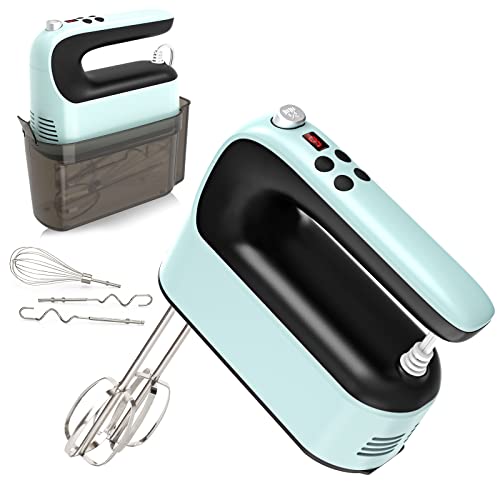
Yomelo 9-Speed Digital Hand Mixer
Best for: precise speed control in handheld mixing
- Speed Settings
- 9 Speeds (what this guide is about)
- Motor Wattage
- 400 W
- Included Attachments
- 2 beaters, 2 dough hooks, 1 whisk
- Operation Mode
- Electric
- Dimensions
- 3.1 × 5.5 × 7.2 inches
- Weight
- 2.76 pounds
View on Amazon: Yomelo 9-Speed Digital Hand Mixer Affiliate link
The Yomelo 9-Speed Digital Hand Mixer offers precise control with nine distinct speed settings. It uses a 400W DC motor to handle tasks from kneading dough to whipping cream. The soft start feature reduces splatter, while the digital display shows your current selection. Weighing 2.76 pounds, it is lightweight and easy to maneuver. This model suits bakers who want granular speed adjustments in a handheld format.
Pros
- Nine speed settings for precise control
- 400W DC motor provides strong torque
- Soft start technology prevents splatter
- Digital screen displays current speed
Cons
- Handheld design limits heavy dough capacity
- No bowl included with the unit
- Lightweight build may feel less stable
Good fit if
- You need fine-tuned speed adjustments for delicate batters
- You prefer a lightweight tool for quick tasks
- You want a digital display for clarity
Skip if
- You primarily mix large batches of stiff bread dough
- You require a stationary stand mixer for hands-free operation
- You need a bowl included in the package
Verdict: The Yomelo 9-Speed Digital Hand Mixer fits users who value precise speed control and a soft start feature for messy ingredients. It is a solid choice for those who mix in batches rather than large volumes.

VEVOR 10-Quart 3-Speed Commercial Stand Mixer
Best for: Heavy dough mixing in commercial settings
- Speed Settings
- 3 Speeds (what this guide is about)
- Bowl Capacity
- 10 qt
- Motor Wattage
- 450W
- Included Attachments
- Dough hook, flat beater, wire whip
- Timer Function
- Timer knob (up to 30 min)
- Application
- Pizza, Bakeries, Dough, Commercial
View on Amazon: VEVOR 10-Quart 3-Speed Commercial Stand Mixer Affiliate link
This VEVOR unit offers a 10 qt stainless steel bowl and a 450W motor with gear-driven transmission. It features 3 speed settings for kneading, mixing, or whipping. The timer knob allows up to 30 minutes of hands-off operation. It includes a dough hook, flat beater, and wire whip. The 124-pound build suits commercial kitchens needing heavy-duty dough handling.
Pros
- 10 qt stainless steel bowl capacity
- 450W gear-driven motor for heavy loads
- 3 adjustable speeds for specific tasks
- Built-in timer knob up to 30 minutes
- Includes dough hook, flat beater, and wire whip
Cons
- Only 3 speed settings limit fine control
- 124-pound weight makes it difficult to move
- No variable speed dial for gradual adjustments
Good fit if
- You need to mix large batches of heavy dough
- You want a timer to prevent overmixing
- You require a durable stainless steel bowl
Skip if
- You need precise speed control for delicate batters
- You require a lightweight appliance for storage
- You prefer a compact countertop footprint
Verdict: VEVOR 10Qt 3-Speed Commercial Stand Mixer is built for high-volume dough mixing rather than versatile baking. It fits commercial kitchens that prioritize capacity and power over speed variety.
Specifications side by side
| Spec | Hamilton Beach 6-Speed Hand Mixer with Case | Cuisinart 5.5-Quart 12-Speed Tilt-Head Stand Mixer | KitchenAid 5-Speed Hand Mixer | Showvigor 7-Speed Pink Hand Mixer | Yomelo 9-Speed Digital Hand Mixer | VEVOR 10-Quart 3-Speed Commercial Stand Mixer |
|---|---|---|---|---|---|---|
| Bowl Capacity | not stated | 5.5 qt | not stated | not stated | not stated | 10 qt |
| Speed Settings | 6 speeds | 12 speeds | 5 speeds | 7 speeds | 9 speeds | 3 speeds |
| Motor Wattage | 250 Watt | not stated | not stated | not stated | 400 W | 450W |
| Head Type | not stated | Tilt-back | not stated | not stated | not stated | not stated |
| Included Attachments | Traditional beaters, whisk | not stated | Turbo Beaters | 2 beaters, 2 dough hooks, 1 whisk | 2 beaters, 2 dough hooks, 1 whisk | Dough hook, flat beater, wire whip |
| Housing Material | not stated | Die-cast metal | not stated | not stated | not stated | not stated |
| Timer Function | not stated | not stated | not stated | not stated | not stated | Timer knob (up to 30 min) |
| Application | not stated | not stated | not stated | not stated | Dough | Pizza, Bakeries, Dough, Commercial |
| Operation Mode | Electric | Manual | not stated | Electric | Electric | not stated |
| Color | White | Coral | White | Pink | Ice Blue/Black | Silver |
| Size | Traditional Beaters | 5.5 Quart | 5 Speed | one size | not stated | 10 Quart |
| Dimensions | 5.7 × 8.3 × 9.2 inches | 14.2 × 7.87 × 14.1 inches | 8 × 3.5 × 6 inches | 1 × 1 × 1 inches | 3.1 × 5.5 × 7.2 inches | 18.4 × 14.8 × 24.2 inches |
| Weight | 2.87 pounds | 1 pounds | 2 pounds | not stated | 2.76 pounds | 124 pounds |
| Model | 62682G | not stated | KHM512WH | 0170 | Y-891 | B10-BT |
Frequently asked questions
Do more speed settings mean a better mixer?
No. More speeds indicate finer control, not greater power. You should prioritize higher counts if your baking requires texture precision. For example, the Cuisinart 12-Speed Stand Mixer offers manual control for delicate batters. Conversely, the VEVOR 3-Speed Commercial Mixer focuses on capacity and heavy dough rather than speed variety.
Is a 3-speed mixer enough for home baking?
It depends on your tasks. Three speeds suit heavy-duty mixing, such as kneading stiff dough. The VEVOR 10-Quart 3-Speed Commercial Stand Mixer is built for high-volume dough in commercial settings. It prioritizes power over speed variety. If you need fine control for meringues, a higher speed count is better.
What is the difference between manual and electric operation modes?
Operation mode describes how you control the mixer. Manual controls require you to adjust settings by hand. The Cuisinart 12-Speed Stand Mixer uses manual controls for precise adjustments. Electric models, like the Hamilton Beach 6-Speed Hand Mixer, use internal motors for consistent performance. Both rely on your input for speed changes.
Can I use a 5-speed mixer for all baking tasks?
A 5-speed mixer handles basic tasks well but lacks fine precision. The KitchenAid 5-Speed Hand Mixer fits users who value simplicity. It is reliable for general mixing. However, it does not offer the extensive range needed for delicate batters. For those needs, consider models with 7, 9, or 12 speeds.
Why choose a 9-speed mixer over a 6-speed one?
Nine speeds provide more incremental adjustments than six. The Yomelo 9-Speed Digital Hand Mixer offers precise control and a soft start feature. This helps manage messy ingredients. If you mix in batches and need specific textures, the extra speeds allow for better consistency. A 6-speed model, like the Hamilton Beach, offers a balanced but broader range.
Do digital displays affect speed control accuracy?
Digital interfaces often enhance precision. The Yomelo 9-Speed Digital Hand Mixer uses a digital interface for clear speed selection. This helps you maintain consistent rotational speeds. Manual models, such as the Cuisinart 12-Speed Stand Mixer, rely on physical dials. Both methods work, but digital displays can reduce guesswork when setting specific velocities.
Is weight a factor when choosing speed settings?
Weight affects stability, not speed capability. Heavier mixers resist movement during high-speed mixing. The VEVOR 3-Speed Commercial Mixer weighs 124 pounds, ensuring stability for heavy dough. Lighter models, like the KitchenAid 5-Speed Hand Mixer at 2 pounds, are portable. Choose based on your need for stability versus storage space, regardless of speed count.
What size bowl do I need for different speed settings?
Bowl size matches your volume, not your speed settings. The Cuisinart 5.5-Quart Stand Mixer suits standard home baking. The VEVOR 10-Quart Mixer handles large commercial batches. Speed settings control how you mix the contents. A 12-speed model can manage a 5.5-quart bowl with precision. A 3-speed model can handle a 10-quart bowl for heavy dough.